Most lifters need 10 to 20 hard sets per muscle group per week to build muscle. That range comes up over and over in training research, and it holds for the vast majority of natural lifters. The exact number depends on your experience, your recovery, and the muscle group in question. But the window is narrower than the internet makes it seem, and landing anywhere inside it puts you ahead of most gym-goers who never count at all.
Why does weekly training volume matter?
Volume, roughly sets multiplied by reps multiplied by weight, is the primary driver of muscle growth over time. A 2017 meta-analysis by Schoenfeld et al. published in the Journal of Sports Sciences found that higher weekly set volumes produced significantly greater muscle growth than lower volumes, with a clear dose-response relationship (Schoenfeld et al., 2017).
That doesn't mean more is always better. It means that how many hard sets you do each week matters more than which exercises you pick, how long you rest, or what tempo you use. Volume is the dial that moves the needle most, and sets per muscle group per week is the simplest way to track it.
A "hard set" here means a working set taken within roughly two to three reps of failure, not a warm-up. If you're unsure where that line sits, our breakdown of warm-up sets vs working sets makes it clear. And if gauging proximity to failure feels fuzzy, understanding RPE and reps in reserve will sharpen that skill quickly.
What does the research say about 10 to 20 sets?
A 2010 meta-analysis by Krieger in the JSCR found that performing 10 or more sets per muscle group per week led to roughly twice the hypertrophy of doing fewer than 5 sets (Krieger, 2010). The gains continued to climb as sets increased toward 20, but with diminishing returns beyond that point.
Here's where it gets practical. The difference between 10 sets and 15 sets is meaningful. The difference between 20 sets and 25 sets is much smaller, and for many people it's actually negative once fatigue and joint stress pile up. Think of volume like sunlight for a plant: more helps up to a point, then it starts to burn.
So where did the 10-to-20 window come from? It's the overlap of multiple studies, reviews, and real-world coaching. Researchers like Brad Schoenfeld and James Krieger have both pointed to this range repeatedly, and coaches like Mike Israetel at Renaissance Periodization have built entire programming systems around it. The consensus is unusually tight for exercise science.
How many sets do beginners need?
Beginners grow on less volume than experienced lifters. A dose-response meta-analysis in Medicine & Science in Sports & Exercise found that untrained lifters made their best gains at markedly lower training doses than trained lifters, who needed more volume for the same progress (Rhea et al., 2003).
Start with 10 to 12 hard sets per muscle group per week. That's enough to trigger growth without burying your recovery. Beginners respond to almost anything, so the real risk isn't doing too little. It's doing too much, getting sore constantly, and quitting.
A beginner running a simple three-day full-body program might do 3 sets of squats twice a week and 3 sets of leg press once. That's 9 sets for quads, right in the sweet spot. If you want the progression framework to pair with that, progressive overload for beginners lays it out week by week.
Most beginner programs settle on roughly 10 weekly sets per muscle group, split across two sessions, which consistently produces visible progress for the first six months. Jumping to 16 or more sets early rarely speeds things up and often leads to burnout or nagging joint pain.
How many sets for intermediate and advanced lifters?
As you gain training experience, you need more volume to keep growing. Your muscles adapt, your recovery improves, and what used to be enough stops working. A meta-analysis of trained athletes in the Journal of Strength and Conditioning Research confirmed that experienced lifters required higher training doses than beginners to continue making progress (Peterson et al., 2004).
Intermediate lifters: 12 to 16 sets
If you've been training consistently for one to three years, 12 to 16 hard sets per muscle group per week is a solid target. You'll typically split this across two sessions for each muscle, which also spreads fatigue more evenly.
Advanced lifters: 16 to 20+ sets
Lifters with three or more years of consistent training often need 16 to 20 sets per muscle group weekly to keep progressing. Some push beyond 20 during specialization phases, but this comes with trade-offs. Recovery demands go up, and you may need to reduce volume on other muscle groups to compensate.
Here's a quick reference:
| Experience level | Weekly sets per muscle group | Typical split |
|---|---|---|
| Beginner (0-1 year) | 10-12 | Full body, 3x/week |
| Intermediate (1-3 years) | 12-16 | Upper/lower or PPL |
| Advanced (3+ years) | 16-20+ | PPL or specialization blocks |
But what about going higher? Can't you just keep adding sets? You can, but the research suggests a ceiling. A 2022 systematic review in the Journal of Human Kinetics concluded that 12 to 20 weekly sets per muscle group maximizes hypertrophy, with no clear additional benefit beyond that range (Baz-Valle et al., 2022). Past that point, you're mostly accumulating fatigue.
The jump from intermediate to advanced volume isn't just about adding sets. It's about earning the right to add them. If you can't recover from 14 sets, doing 20 won't make you grow faster. It'll make you tired.
Does every muscle group need the same volume?
No. Larger muscle groups can generally tolerate and benefit from more volume than smaller ones. Your quads have far more muscle tissue than your rear delts, and they recover differently. Treating them the same wastes effort in one direction and leaves gains on the table in the other.
Larger muscle groups: higher volume
Quads, back, and chest tend to respond well to higher set counts, often 14 to 20 weekly sets for intermediate and advanced lifters. These are big muscle groups driven by compound movements, and they can absorb more work before recovery becomes an issue.
Smaller muscle groups: lower volume
Biceps, triceps, side delts, and rear delts often grow well on 8 to 14 weekly sets. They also get indirect volume from compound lifts. Your triceps work during every pressing movement. Your biceps work during every row and pull-up. You don't need to double up.
Here's a rough guide:
- Quads: 12-20 sets
- Back (lats and upper back): 12-20 sets
- Chest: 10-18 sets
- Hamstrings: 10-16 sets
- Shoulders (side and rear delts): 8-16 sets
- Biceps: 8-14 sets
- Triceps: 8-14 sets
- Calves and abs: 6-12 sets
Remember, these include indirect volume. If you bench press for 4 sets twice a week, that's 8 sets hitting your triceps before you do a single isolation movement.
A common mistake is doing 16 sets of direct bicep work on top of 16 sets of back work. The biceps are already working hard during rows and pull-ups. That extra direct volume often just inflames the elbow without adding arm size.
How do you know if your volume is too high or too low?
Your body gives clear signals. You don't need a lab to figure this out; you just need to pay attention and track what you're doing.
Signs your volume is too low
- Workouts feel easy and you're rarely sore or fatigued.
- Strength isn't improving over a four to six week block.
- You finish sessions feeling like you barely trained.
- You're recovering fully within 24 hours with zero stiffness.
Signs your volume is too high
- Performance is dropping. Weights that used to be manageable feel heavy.
- Joint pain, not muscle soreness, lingers between sessions.
- Sleep quality declines and motivation craters.
- You're always fatigued before the session even starts.
If the second list sounds familiar, it might be time for a deload week before reducing your ongoing volume. A deload lets accumulated fatigue clear so you can actually see what your body can handle fresh.
How should you add volume over time?
Don't jump from 10 sets to 20 overnight. Volume increases should be gradual, just like adding weight to the bar. This is progressive overload applied to volume instead of load.
A practical approach is to add one to two sets per muscle group every two to three weeks within a training block. Run that block for six to eight weeks, then pull volume back during a deload, and start the next block slightly higher than where the last one began.
Here's what that looks like:
- Week 1-2: 12 sets per muscle group (baseline).
- Week 3-4: 14 sets (add one set to two exercises).
- Week 5-6: 16 sets (add another set or a new exercise).
- Week 7: Deload to 8 sets (half volume, same weights).
- Week 8: Start next block at 13-14 sets.
This sawtooth pattern keeps you progressing without running yourself into the ground. And it only works if you know exactly what you did last block, which brings us to tracking.
The bottom line
Aim for 10 to 20 hard sets per muscle group per week. Beginners sit near 10, intermediates near 14, and advanced lifters push toward 20. Larger muscles tolerate more; smaller muscles need less, especially when compound lifts already hit them indirectly. Add volume gradually over training blocks, pull back when fatigue signals pile up, and don't confuse doing more with doing better.
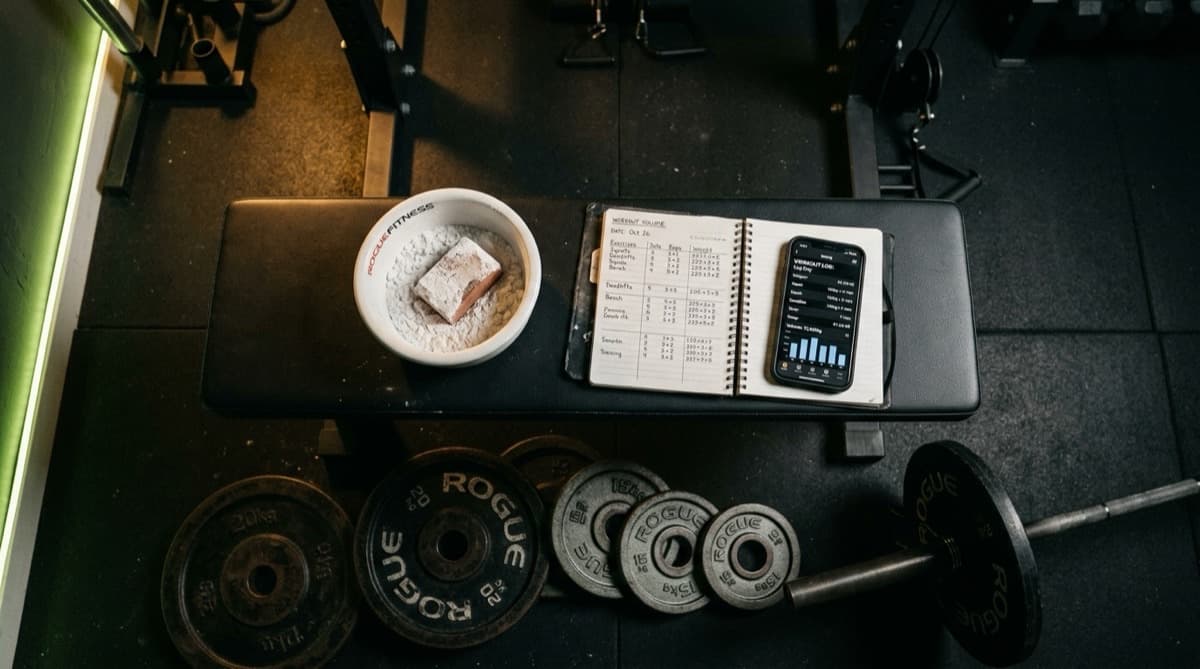
The only way to manage volume well is to track it. If you don't know how many sets you did for chest last week, you can't decide whether this week needs more, fewer, or the same. That's what BeatLast is built for: it tracks your sets and reps session by session so you always know your numbers and can make volume decisions based on data, not memory.
Frequently asked questions
- How many sets per muscle group per week for beginners?
- Beginners should aim for 10-12 hard sets per muscle group per week. This is enough to build muscle and strength without overwhelming your recovery capacity.
- Is 20 sets per muscle group too much?
- For most lifters, 20 sets per muscle group per week is near the upper limit of productive volume. Going beyond that rarely adds growth and often increases fatigue and injury risk.
- Do warm-up sets count toward weekly volume?
- No. Only working sets — sets taken close to failure with your target load — count toward your weekly volume. Warm-up sets prepare you but don't provide a meaningful growth stimulus.