RPE, or Rate of Perceived Exertion, is a 1-10 scale that measures how hard a set felt based on how many reps you had left. It sounds deceptively simple. Yet a systematic review with meta-analysis found that lifters who stop short of failure build comparable muscle to those who grind every set to true failure, with less accumulated fatigue (Refalo et al., Sports Medicine, 2022). That finding has reshaped how evidence-based coaches program intensity.
If you already understand sets and reps, RPE adds one crucial layer: it tells you how hard those sets should be. This guide breaks down the full RPE scale, maps it to reps in reserve, and gives you practical rules for using both in your training.
Key Takeaways
- RPE rates set difficulty on a 1-10 scale based on reps you had left
- RPE 7-8 builds comparable hypertrophy to training to failure (Refalo et al., Sports Medicine, 2022)
- Compound lifts suit RPE 7-8; isolation work can push to RPE 8-9
- RPE estimation accuracy improves with consistent practice over 4-6 weeks
What Is RPE in Weight Training?
The RPE scale for lifting was adapted from Gunnar Borg's original 6-20 cardio exertion scale, an adaptation widely credited to powerlifting coach Mike Tuchscherer of Reactive Training Systems around 2008. It assigns a number from 1 to 10 to every working set based on how many additional reps you could have completed.
An RPE of 10 means you hit absolute failure. You physically could not complete another rep with acceptable form. An RPE of 7 means you finished the set with roughly three reps still available. The gap between those two ratings captures the core program design decision: how close to your limit should each set go?
Why does this matter? Because proximity to failure is one of the strongest predictors of whether a set actually stimulated growth. A 2016 validation study confirmed that experienced lifters could rate RPE within one rep of actual failure with high consistency (Zourdos et al., Journal of Strength and Conditioning Research, 2016).
The RPE Scale: Every Rating Mapped to Reps in Reserve
Zourdos et al. confirmed in 2016 that the resistance training RPE scale produces reliable, repeatable ratings across sessions for lifters with at least one year of experience (Zourdos et al., JSCR, 2016). The table below maps each RPE value to its corresponding reps in reserve.
| RPE | Reps in Reserve | What It Feels Like |
|---|---|---|
| 10 | 0 | Maximum effort. No more reps possible. |
| 9.5 | 0 | No more reps, but could add a small amount of weight. |
| 9 | 1 | One more rep was definitely available. |
| 8.5 | 1-2 | Definitely one more, possibly two. |
| 8 | 2 | Two more reps were available. |
| 7.5 | 2-3 | Two for sure, maybe three. |
| 7 | 3 | Three more reps available. |
| 6 | 4+ | Light effort. Warm-up territory. |
Half-point ratings exist because effort doesn't always land on a whole number. Most lifters find these half-steps useful after a few weeks of consistent logging. If you're new to RPE, stick with whole numbers until your internal gauge sharpens.
How Does RPE Differ from Percentage-Based Training?
Percentage-based programs prescribe loads as a fraction of your one-rep max. A review in Sports Medicine examined autoregulated methods, including RPE-based loading, and concluded they let lifters match training load to daily readiness in a way fixed-percentage programs cannot (Greig et al., 2020). The key difference is daily flexibility.
With percentages, your program might call for "squat 80% of your 1RM for 3 sets of 5." That works well on paper. But what happens when you slept poorly, skipped a meal, or had a grueling week at work? That 80% could feel like 90%.
RPE solves this. Instead of locking you into a fixed load, it asks: how hard was that set? If 80% felt like RPE 9 instead of the planned RPE 7, you drop weight. If it felt like RPE 6, you add. The load adjusts to your actual capacity that day.
RPE works best when paired with a target weight range, not as a total replacement for percentages. Use your training logs to establish a baseline load, then let RPE fine-tune within a 5-10% window. This hybrid approach gives you structure and flexibility at the same time.
How Hard Should Most Sets Feel?
A 2022 systematic review found that stopping short of failure produces hypertrophy comparable to training to failure, while generating less systemic fatigue (Refalo et al., Sports Medicine, 2022). For most lifters, that translates to RPE 7-8 on the majority of working sets.
Hypertrophy (Muscle Growth)
Aim for RPE 7-8 on most sets. This keeps you in the productive zone without piling up fatigue that limits your weekly volume. You grow from the stimulus, not from suffering through every rep.
Strength Development
Working sets can push to RPE 8-9. Heavier loads naturally demand higher effort, but regular failure isn't necessary for strength gains.
Deload Weeks
Drop to RPE 5-6. The goal here is active recovery, not growth stimulus.
What about going all the way to RPE 10? Failure has its place, especially on the last set of an exercise or during planned intensity blocks. But it shouldn't be your default. Chronic failure training increases injury risk and slows recovery between sessions.
Does RPE Change by Exercise Type?
Research from Hackett et al. found that experienced lifters can estimate how many reps they have left on big compound lifts like squats and bench press with reasonable accuracy, and that accuracy sharpens as sets approach failure (Hackett et al., Journal of Sports Sciences, 2012). In practice RPE is harder to gauge on isolation work, so your target RPE should shift depending on exercise selection.
Compound Movements
Squats, deadlifts, bench press, and rows should generally stay at RPE 7-8. These movements load multiple joints and large muscle groups. Fatigue from compounds accumulates fast and affects your entire session.
Isolation Movements
Curls, lateral raises, and leg extensions can safely push to RPE 8-9. Single-joint movements carry less systemic fatigue and lower injury risk at high effort levels. Missing your RPE estimate by one point on a curl won't wreck your recovery the way it would on a heavy deadlift.
In practice, most lifters find RPE harder to gauge on isolation work. The localized "burn" in a muscle doesn't always indicate proximity to failure. A simple gut check helps: could you have done two more clean reps? If yes, you're at RPE 8 or below.
How Do You Get Better at Estimating RPE?
In Zourdos et al.'s validation study, experienced lifters estimated their reps in reserve to within about one rep of actual failure, with accuracy at its best on sets taken close to their limit (Zourdos et al., JSCR, 2016). RPE accuracy is a trainable skill. Here's how to sharpen it.
Run Occasional AMRAP Sets
Once a week, take your last set of a major lift to true failure in a safe setup. Compare your predicted reps in reserve to what you actually completed. This calibrates your internal gauge against reality.
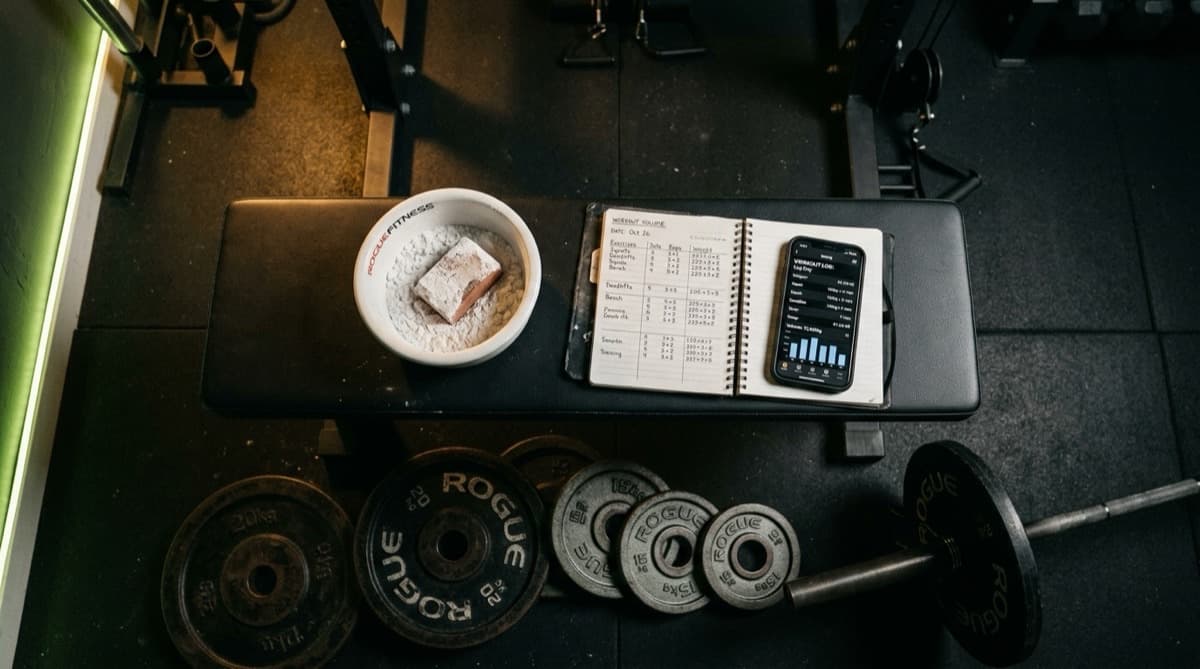
Log RPE Immediately After Each Set
Write down your RPE before you rest, not at the end of the session. Memory distorts effort perception quickly. Waiting even ten minutes tends to flatten everything into "that was hard."
Film Your Working Sets
Watch bar speed on your final reps. If the bar crawled on a set you rated RPE 7, you're likely underestimating effort. Video feedback tightens calibration within weeks.
Most beginners overestimate how many reps they have left. A set they call RPE 7 is often closer to RPE 8.5 when tested against true failure. After about four to six weeks of consistent logging, estimates tighten up considerably.
Common RPE Mistakes That Stall Progress
Morán-Navarro et al. found that sets taken all the way to failure markedly extended recovery time compared to stopping a few reps short at matched volume (Morán-Navarro et al., European Journal of Applied Physiology, 2017). Two patterns account for most RPE-related training problems.
Always Pushing to RPE 10
Some lifters treat every set like a final exam. That mentality works short-term but leads to burnout, joint stress, and stalled progress within weeks. Reserve RPE 9-10 for planned intensity phases or the last set of an exercise.
Sandbagging at RPE 6
The opposite mistake is equally harmful. If every set feels comfortable, you're not providing enough stimulus for adaptation. RPE 6 is warm-up territory, not a training zone for working sets.
Ignoring RPE Drift Within a Session
As fatigue builds, the same weight feels progressively harder. Your first set of squats might be RPE 7. By set four, it could be RPE 9. That's completely normal. Accept the drift and adjust expectations rather than forcing identical RPE across every set.
Using RPE for Day-to-Day Autoregulation
In a 12-week randomized trial, Graham and Cleather found that lifters whose daily loads were adjusted using reps in reserve gained more strength than those following fixed percentage-based loading (Graham & Cleather, JSCR, 2021). Autoregulation means adjusting your training weights based on how the bar moves today, not what a spreadsheet says.
Here's how it works in practice. Your program calls for 3x5 squats at RPE 8. You load last week's weight and complete set one. If it felt like RPE 7, add 2.5 kg for set two. If it felt like RPE 9, hold the weight or drop slightly. Small adjustments, big compounding effect.
The real power of autoregulation reveals itself over months, not single sessions. On any given day, the weight difference is small. Over 12 weeks, RPE-guided lifters accumulate more quality volume because they push harder on good days and pull back on bad ones. Fixed programs simply can't adapt like that.
Track your planned RPE versus actual RPE in your training log. Patterns will emerge. If you're consistently overshooting by a full point, your baseline weights are probably set too high.
The bottom line
RPE gives you a practical answer to the most fundamental training question: was that set hard enough? For most lifters, the answer lives at RPE 7-8. Train there consistently, push to RPE 9-10 strategically, and you'll build muscle without burning out.
The real value of RPE compounds over time. As you log more sessions, your self-awareness sharpens. You learn what productive effort actually feels like, not just what the numbers on the bar suggest. Pairing RPE ratings with objective tracking, logging your weights, sets, and reps in a tool like BeatLast, gives you the full picture: subjective effort backed by hard data.
Start simple. Rate your next three sets. Compare your predictions to reality. Within a month, you'll wonder how you ever trained without this feedback loop.
Frequently asked questions
- What does RPE mean in weight training?
- RPE stands for Rate of Perceived Exertion. In weight training, it is a 1-10 scale where 10 means you could not have done another rep and lower numbers mean you had more reps left in the tank.
- What RPE should I train at?
- Most of your working sets should fall between RPE 7 and 8, meaning you finish each set with 2-3 reps still in reserve. This gives a strong training stimulus while keeping fatigue manageable.
- Is RPE the same as reps in reserve?
- They are closely related but inverse. RPE 10 equals 0 reps in reserve (failure). RPE 9 equals 1 RIR, RPE 8 equals 2 RIR, and so on. Most coaches use them interchangeably in practice.