Tracking your workouts means writing down what you actually lifted, set by set, so the next session has a number to beat. That is the whole job. The method barely matters, and the habit is everything. Most people quit tracking not because their tool was wrong, but because they logged after the gym instead of during it, from memory that had already gone fuzzy.
Why track your workouts at all?
If you train to get stronger, you are trying to do slightly more than last time. You can't do more than a number you don't know. That is the entire case for tracking: it turns "I think I did around 60 kg" into "I did 60 kg for 8, 8, 7 last Tuesday, so today I chase 8, 8, 8."
Without a record, training drifts into maintenance. You repeat comfortable weights, feel like you worked hard, and wonder why the mirror never changes. The logbook is the feedback loop that makes progressive overload possible instead of theoretical.
This isn't just gym wisdom either. A meta-analysis of 138 studies found that monitoring progress toward a goal reliably raised the odds of reaching it, and the effect was stronger when people physically recorded the results rather than just keeping them in their head (Harkin et al., 2016). Writing the number down does something remembering it can't. It makes the gap between where you are and where you want to be impossible to ignore, and that gap is what pulls the next session forward.
The pattern holds well beyond the gym. In weight-loss research, self-monitoring — writing down what you eat, what you weigh, or what you do — is one of the most consistent predictors of who succeeds and who stalls, across decades of studies (Burke et al., 2011). The mechanism is the same whether the number is a bodyweight or a barbell: the act of recording forces attention onto the behaviour you're trying to change, and attention is what keeps you honest. A set you have to write down is a set you can't quietly round up in your memory.
What are the ways to track workouts?
There is no single right tool. There is the one you will actually open mid-set, week after week. Here is an honest look at the common options, warts included.
Pen and notebook
Cheap, fast, never runs out of battery, and works in any gym on earth. The downside is retrieval: flipping back three weeks to find your last squat session is slow, and doing any trend maths by hand is nobody's idea of fun. Great for logging, poor for looking back. There's also a quiet upside people underrate — no notifications, no apps competing for your thumb, nothing pulling you into a scroll between sets. If your phone is a distraction magnet at the gym, paper sidesteps that entirely. Just know a notebook is a write-only medium in practice: data goes in easily and comes out slowly.
Notes app on your phone
Already in your pocket, syncs across devices, easy to start. But a wall of plain text gets messy fast, and it won't surface last session's numbers for you. You still scroll and squint. Fine for a while, frustrating once you have months of history. The other trap is the lack of structure: because a notes app imposes nothing, you invent your own format, and that format quietly drifts week to week until old entries are hard to parse at a glance. It works best if you commit to one rigid layout — same order, same shorthand — and never deviate.
Spreadsheet
The power-user choice. You can build charts, formulas, estimated one-rep-max columns, whatever you like. The catch is friction: tapping into the right cell between sets, on a phone, with chalky hands, is clumsy. Brilliant for people who enjoy the spreadsheet. Abandoned by people who don't. A middle path some lifters use is logging on paper or in a note during the session, then transferring into the spreadsheet at home where the charts and one-rep-max estimates live. That keeps the friction out of the gym, at the cost of doing the same job twice — worth it only if you genuinely enjoy the analysis, and a chore that quietly gets skipped if you don't.
Dedicated tracker apps
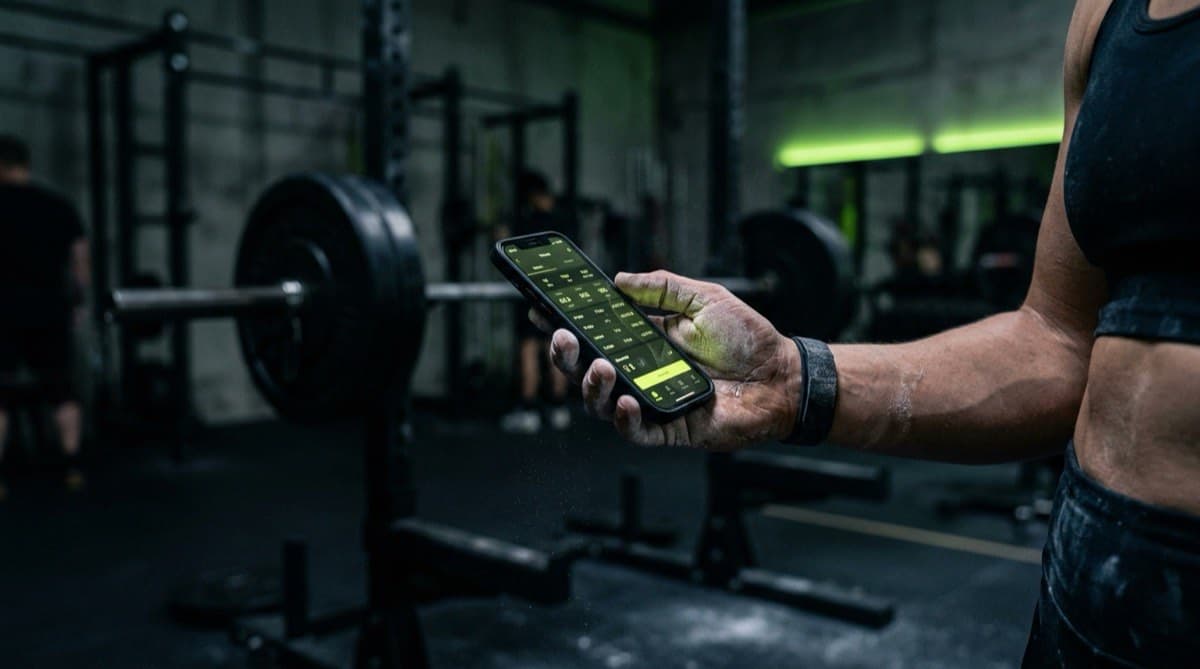
Purpose-built to log during a session and show your last numbers automatically. The good ones remove the two jobs you'd otherwise do by hand: finding last session, and spotting personal records. The trade-off is you adopt someone else's structure, and quality varies a lot between apps. Three things are worth checking before you commit: does it show last session inline while you log, or make you dig for it; does it work offline, since gym basements eat signal; and can you export your data if you ever leave? An app that nails logging speed but locks up your history is a trade you'll regret months in, once that history is the whole point.
Which tracking method is best?
Best is the one that gets last session's numbers in front of your eyes at the moment you load the bar. Judge any method on that single test. A notebook you flip through fails it slightly; an app that pins your previous set beside the input passes it cleanly. Speed of retrieval, not features, decides whether a tool survives contact with a real gym.
- Want zero setup and no screen? Notebook. Accept the slow look-back.
- Love data and tinkering? Spreadsheet, if you'll tolerate the thumb-typing.
- Want the numbers handed to you mid-set? A dedicated tracker.
What should you actually write down?
Keep it lean. For every working set you need three things: the exercise, the weight, and the reps you hit. That trio is the whole backbone of progressive overload, and it's enough to tell whether today beat last time. You can skip the warm-up sets if you want, since it's the working sets that carry the signal you're chasing.
Two optional fields earn their place once you're a few months in. A quick note on how a set felt, easy, tough, or a proper grind, tells you whether a weight is ready to climb next session. And flagging any set that beats your previous best turns a scroll of numbers into visible personal records. Everything past those five fields is nice-to-have, not need-to-have, so don't let a fancy template become the reason you stop logging.
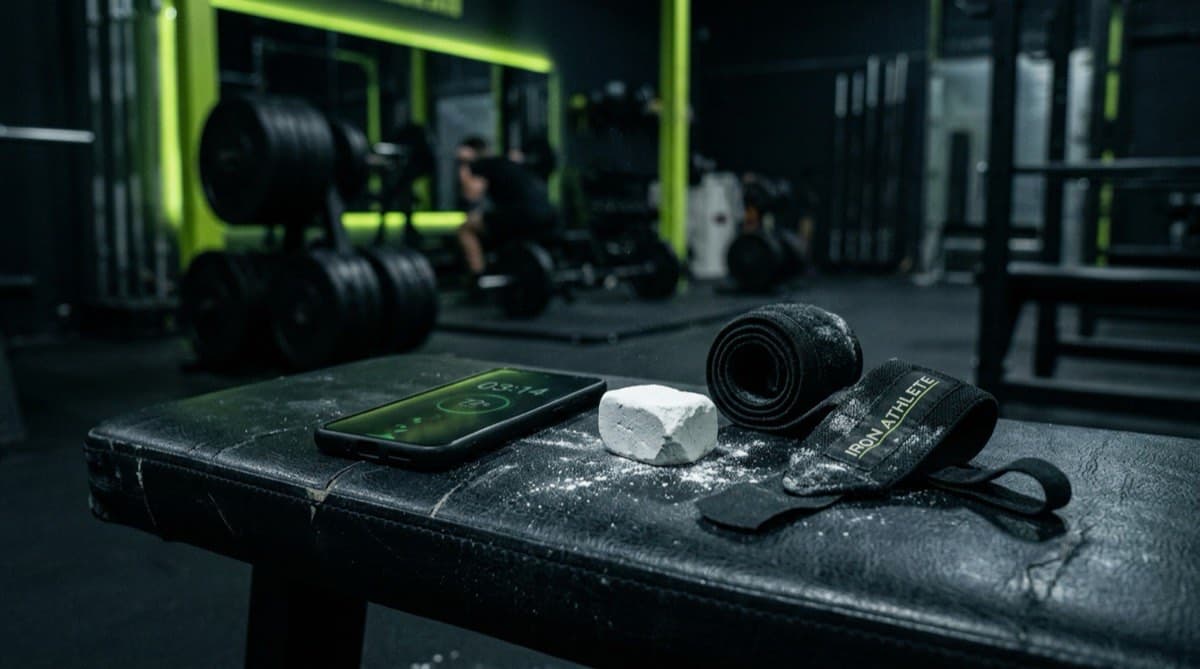
If you want to sharpen that "how it felt" note, two extra data points are worth understanding even if you don't record them every set. The first is effort, which you can capture as RPE or reps in reserve — a rough read of how many reps you had left in the tank. Logged next to weight and reps, it tells you whether a grindy top set was a one-off or a signal the weight's ready to go up. The second is rest between sets, because the same weight for the same reps means something very different on ninety seconds versus three minutes. You don't need to stopwatch every rest, but when your numbers dip for no obvious reason, a shrinking rest period is often the hidden culprit — there's more on getting that dial right in how long to rest between sets.
Why do most people quit tracking?
The failure is almost never the tool. It is timing. People try to log the whole session afterwards, on the drive home or that evening, and reconstruct it from memory that has already blurred which set was 8 reps and which was 7. Do that twice and the log is full of guesses. A log full of guesses is useless, so it gets abandoned.
The fix is one habit: log during the session, one set at a time, the second you rack the weight. It takes five seconds and the number is exact. This is also where rep ranges help you decide what to write down next, covered in reps and sets explained.
The habit that makes tracking stick
Treat logging as part of the set, not paperwork you do later. Finish the set, rack the bar, tap in the reps and weight, rest, repeat. When the entry lives inside the rest period you were going to take anyway, it costs you nothing and stays accurate.
This is the reasoning behind BeatLast: it shows last session's exact sets, reps and weight next to each set as you log, so the target is always one glance away and you never track from memory. If you'd rather see the app flow step by step, read getting started with BeatLast. And if a notebook keeps you consistent instead, that beats any app you stop opening.
What do you do with all that data?
Logging is only half the loop; the other half is looking back. Once a month, skim the last few weeks of a lift and ask one question: is the top-line number, weight times reps, trending up? If it is, keep doing exactly what you're doing. If it's been flat for three or four weeks, that's a plateau you can now actually see, and there's a fix-it guide for exactly that in how to break a lifting plateau.
It helps to run this on two clocks. Weekly, you're only asking a small question: did I hit or beat the numbers I was chasing this session? That's a thirty-second glance, and it tells you what to load next time. Monthly is the wider view — the trend across four or five sessions of the same lift, where a real stall becomes visible that any single week would hide. The weekly check keeps you honest; the monthly one keeps you from panicking over a single off day, which happens to everyone and rarely means anything on its own.
This pairing of recording plus review isn't incidental. Interventions that combined self-monitoring with a plan to act on what the record showed were measurably more effective at changing physical-activity behaviour than monitoring on its own (Michie et al., 2009). The log is the input; the look-back is what turns it into a decision. Numbers you never read are just data entry.
You don't need graphs to run that check, though they make it faster. A tracker that draws the trend line for you turns a wall of numbers into a shape you can read in two seconds. The point was never the chart itself. It's catching a stall early, while it's still one bad month, instead of grinding through it for a whole season before you notice something's off.
The bottom line
Pick whichever method you'll open every session, then log during the workout rather than after it. Notebook, notes app, spreadsheet or tracker, they all work if last session's numbers are in front of you when you load the bar. The consistency is the point. The tool is just the thing that holds the numbers.
Frequently asked questions
- What's the best way to track workouts?
- The best method is the one you'll actually open mid-set, week after week. A notebook, notes app, spreadsheet, or dedicated tracker all work; consistency matters far more than the tool.
- Why do most people quit tracking their workouts?
- Most quit because they log from memory after the gym instead of during it. Logging each set as you finish it keeps the numbers accurate and the habit sustainable.
- Do I need to track every single set?
- For progressive overload, yes. You can only beat a number you actually recorded, so logging weight and reps for each working set is what makes the next session measurable.